Choosing a web design and development agency? Learn what to check, the 8 questions to ask, how to read a quote and the red flags to avoid before you hire.
Hiring a web design and development agency is one of the bigger decisions a small business makes online. Choose well and you get a fast, professional website that brings in enquiries for years. Choose badly and you can end up with a missed deadline, a site you do not control, or a rebuild twelve months later.
The problem is that almost every agency looks good on its own website. Portfolios are polished, promises are big and prices vary wildly. This guide gives you a practical way to compare agencies in 2026: what to check, which questions to ask, which warning signs to watch for and how to read a quote. It applies whether you are in the US, the UK or anywhere else.
What does a web design and development agency actually do?
A web design agency usually focuses on how your site looks and feels: layout, branding, user experience and visuals. A web development agency builds the working website: code, features, forms, speed, security and hosting setup. Many agencies, including Leadssinc, do both, and often add SEO, content and ongoing support.
It helps to know what you need before you start talking to agencies:
- A new website for a new or growing business.
- A redesign of a site that looks dated, loads slowly or no longer converts. Our website redesign checklist covers this in detail.
- An online store to sell products.
- A custom feature or web app, such as bookings, portals or dashboards.
- Ongoing care, such as updates, security, backups and fixes.
What to do: Write a one-page brief with your goals, your must-have pages and features, your budget range and your target launch date. A clear brief gets you better quotes and quickly shows which agencies listen.
Step 1: Look at the work, not just the design
Start with the portfolio, but look past the screenshots.
- Is the work relevant? Experience in your industry or with a similar type of site is helpful, because the agency already understands your customers.
- Do the sites work well? Open some live projects on your phone. Check how fast they load, whether they are easy to use and whether the pages look consistent.
- Is there variety, and is it real? Agencies sometimes show mock-ups or work they did not build. Ask which sites are live and what the agency was responsible for.
- Do they show results? Faster speed, more enquiries or better rankings tell you more than pretty designs.
Free tools such as Google PageSpeed Insights let you test a live portfolio site in seconds, which tells you whether the agency builds fast sites in practice.
Step 2: Ask these eight questions
A good agency answers clearly and without pressure. These questions show how an agency works.
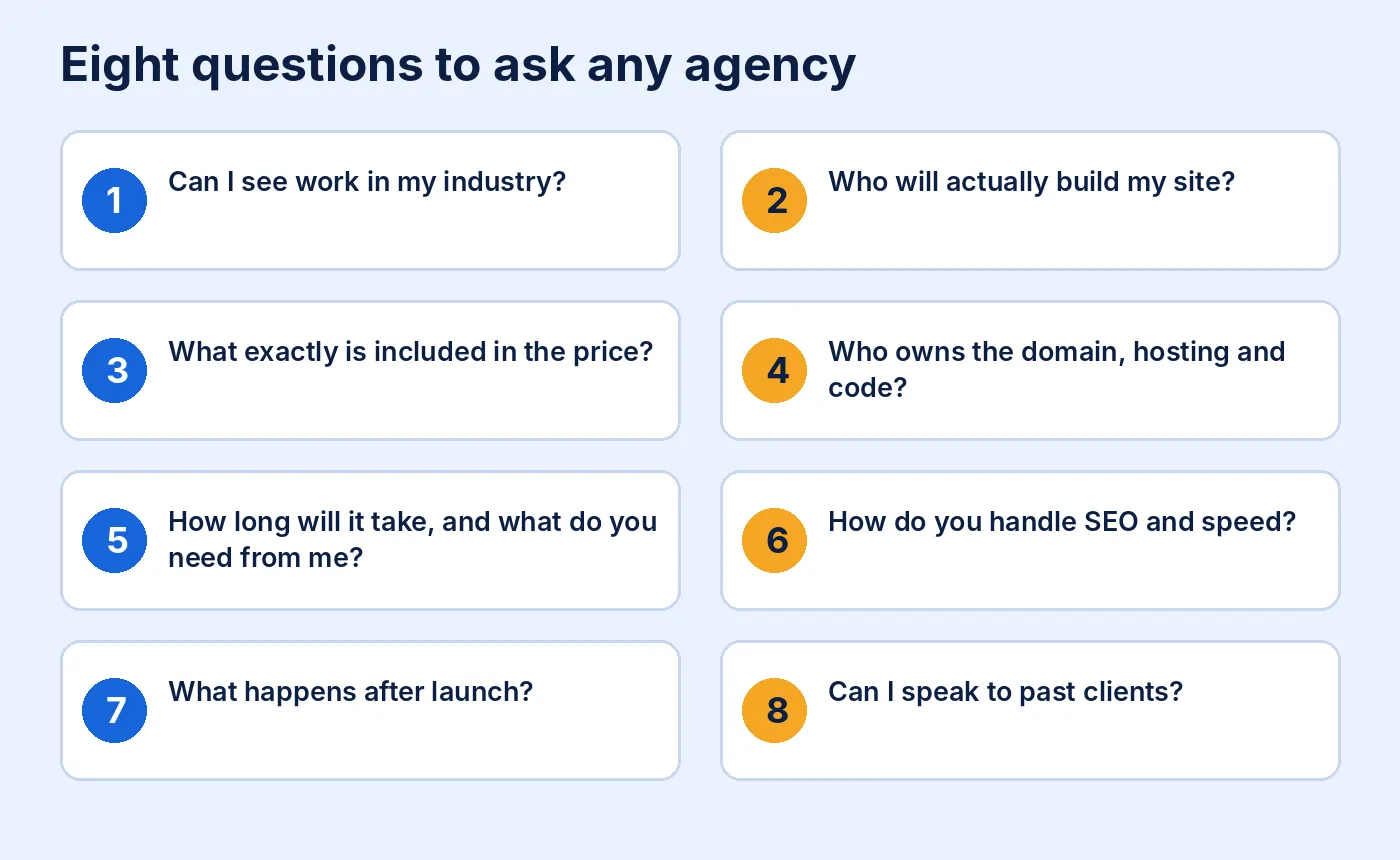
- Can I see work in my industry? You want proof they understand businesses like yours.
- Who will actually build my site? Find out whether you will deal with experienced people or whether the work is passed to a junior team or subcontractors, and who your main contact will be.
- What exactly is included in the price? Pages, features, design revisions, content, SEO setup and training should all be listed.
- Who owns the domain, hosting and code? You should. Your domain and hosting accounts should be registered in your name or company name.
- How long will it take, and what do you need from me? Realistic answers include deadlines for your content and feedback, because late content delays most projects.
- How do you handle SEO and speed? Basic SEO setup, mobile design and fast loading should be part of a professional build, not extras you discover later.
- What happens after launch? Ask about support, fixes, updates and what a care plan costs.
- Can I speak to past clients? Confident agencies are happy to share references.
What to do: Send the same questions to every agency on your shortlist, in writing. Comparing written answers is far easier than comparing sales calls.
Step 3: Check the technology and platform
A good agency recommends what fits your business, not whatever it is most comfortable selling. The main options are:
- WordPress, which is affordable and easy to edit, but can become slow if it is built with a heavy theme and many plugins.
- Shopify, a hosted platform that suits online stores. We compare it with WordPress in our guide to WordPress vs Shopify.
- Custom-coded sites (for example Next.js, React and Node.js), which cost more but give you speed, full ownership and unique features.
If an agency pushes one option for every client without asking about your goals, be careful. Ask why it recommends a platform and what the long-term costs are. Our guide to how much a website costs in 2026 explains the price differences.
Step 4: Read the quote carefully
A quote tells you a lot about an agency. A good one is specific.
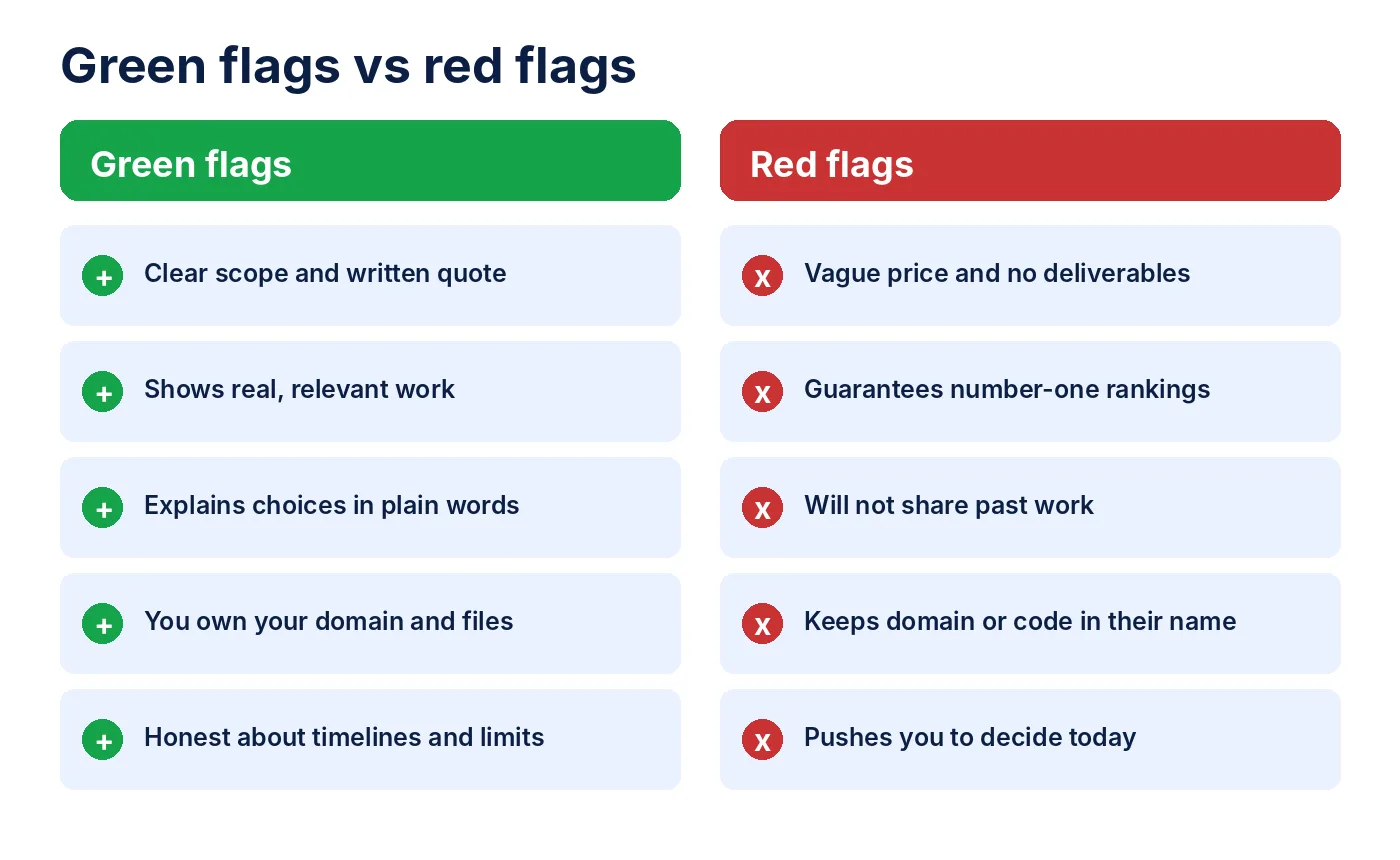
It should list the pages and features, how many design revisions are included, the platform and who pays for hosting, who provides the content and images, what SEO and speed setup is included, the timeline and payment milestones, and what support you get after launch.
Be careful with quotes that are far cheaper than the rest. A very low price often means a heavily templated site, limited revisions, no SEO setup or extra charges later. A very high price is not automatically better either, so ask what you are getting for the difference.
Also check the payment structure. A deposit followed by milestone payments is normal. Paying everything upfront with no milestones puts all the risk on you.
What to do: Put the quotes side by side and compare what is included, not only the total. A cheaper quote with less included is often the more expensive option.
Green flags and red flags
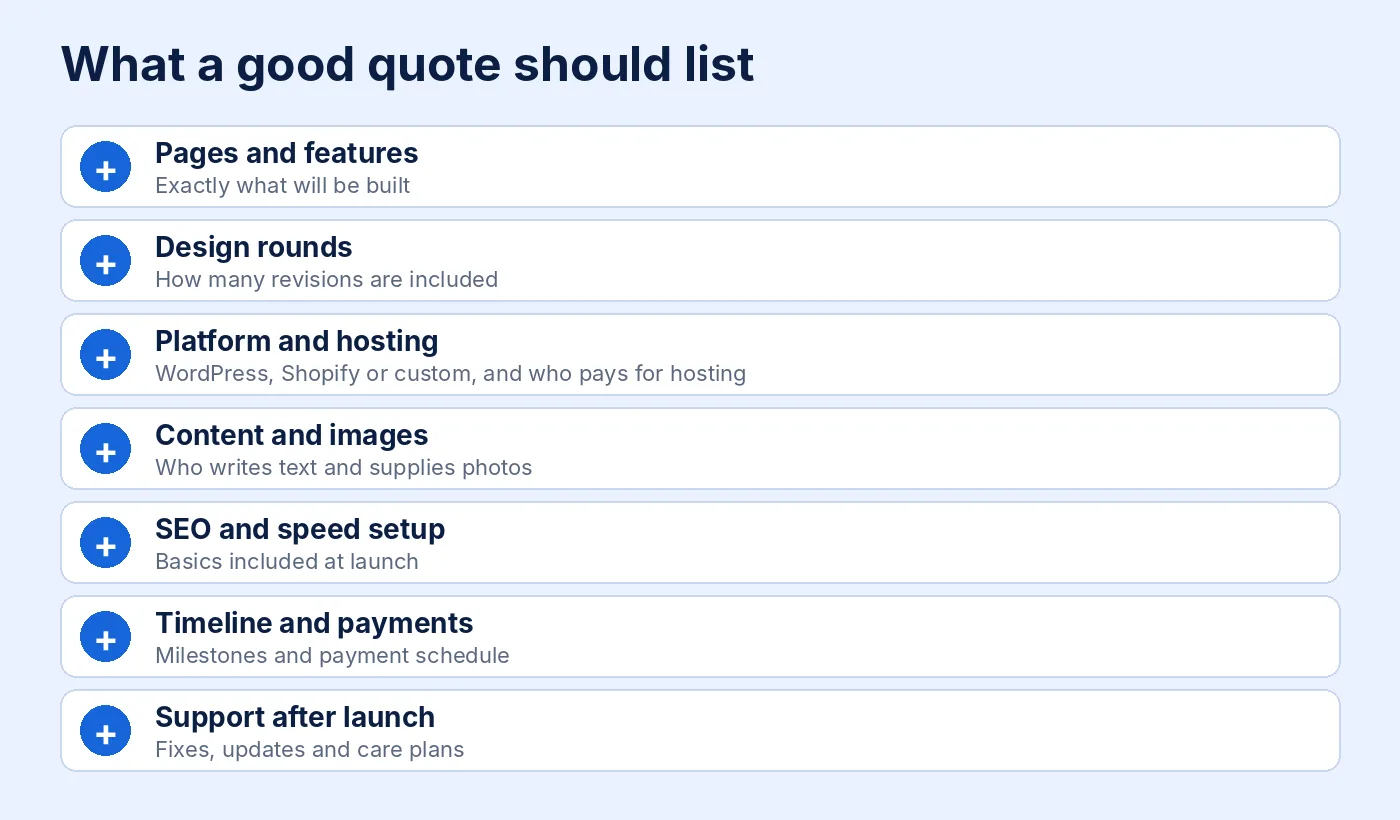
Green flags
- A clear scope and a written quote.
- Relevant, live work you can check yourself.
- Plain-language explanations instead of jargon.
- You own your domain, hosting and files.
- Honest advice about timelines, limits and what is not needed.
- A proper process: discovery, design, build, testing and launch.
Red flags
- A vague price with no list of deliverables.
- Guarantees of number-one Google rankings. Nobody controls Google.
- A portfolio they cannot back up, or no willingness to share references.
- Keeping your domain, hosting or code in their name.
- Pressure to sign today because of a "special offer".
- No mention of mobile design, speed, security or SEO.
- No plan for what happens after launch.
Freelancer, small agency or large agency?
Each has strengths.
- Freelancers often cost less and give you direct contact with the person doing the work. The risk is that one person may be unavailable or limited to certain skills.
- Small agencies combine design, development and SEO in a team, usually with more flexibility and personal service than a large firm.
- Large agencies offer broad resources and process, but charge more, and a small business may not be a priority.
For many small and mid-sized businesses, a small, specialist agency offers the best balance. Whatever you choose, judge the people, the process and the proof, not the label.
Working with an agency in another country
Many businesses in the US and UK work with agencies in other countries, and it can work very well when communication is strong. Check these basics:
- Time zones and response times. Agree on how and when you will communicate.
- Contracts and ownership. Make sure your rights to the code, design and content are in writing.
- Payment methods and tax. Confirm currency, invoices and any tax details.
- References. Speak to clients in your own market where possible.
Location matters less than clarity, reliability and a track record you can verify.
What to expect after you hire
A well-run project follows predictable steps: a kickoff call, a content and design phase, a staging site where you review progress, testing, launch and a handover. You should know who your contact is, when feedback is due and what happens at each stage.
After launch, ask for training on how to edit your site, a copy of key logins, and a plan for updates and support. Your website should be treated as a business asset that needs care, speed checks and updates over time. If you plan to grow through search, pair the site with an SEO plan, and see our guide to how much SEO costs for a small business. Good hosting also affects speed and reliability, so read our guide to the best web hosting in 2026.
Common questions
How much does a web design agency cost? It depends on the platform, the number of pages and the features. Template-based WordPress sites cost less than custom-coded ones, and online stores cost more than brochure sites. Ask for a written quote that lists what is included.
How long does it take to build a business website? A small business site usually takes a few weeks to a couple of months. The timeline depends on the number of pages, how quickly you supply content and feedback, and any custom features.
Should I choose the cheapest agency? Not automatically. Very low prices can mean limited work or extra charges later. Compare the scope, the quality of past work and the support, not only the price.
Do I need a web designer or a web developer? A designer shapes how the site looks, and a developer builds how it works. For most businesses, an agency that does both avoids hand-over problems between two separate providers.
Who should own my website? You should. Your domain, hosting accounts, design files and content should belong to you, and the contract should say so.
Ready to talk to an agency?
Leadssinc designs and builds websites for businesses in the USA, the UK and worldwide, from WordPress and Shopify to custom-coded sites. We give clear quotes, explain your options in plain language and make sure you own everything we build. Tell us about your project and we will recommend the right approach. Visit our web development services, or use our cost calculator to get a starting price.
Found this useful?