How much does SEO cost for a small business in 2026? See typical US and UK prices, what a good plan includes, and the red flags to avoid before you hire.
Ask three agencies how much SEO costs and you may hear $300 a month, $1,500 a month and $10,000 a month. All three can sound convincing, which is why so many small business owners feel stuck before they even start. The truth is that SEO pricing is not random. It follows scope, competition and the quality of the work.
This guide explains how SEO is priced in 2026, what small businesses in the US and UK typically pay, what you should get for the money, and how to spot quotes that are too good to be true.
How much does SEO cost for a small business?
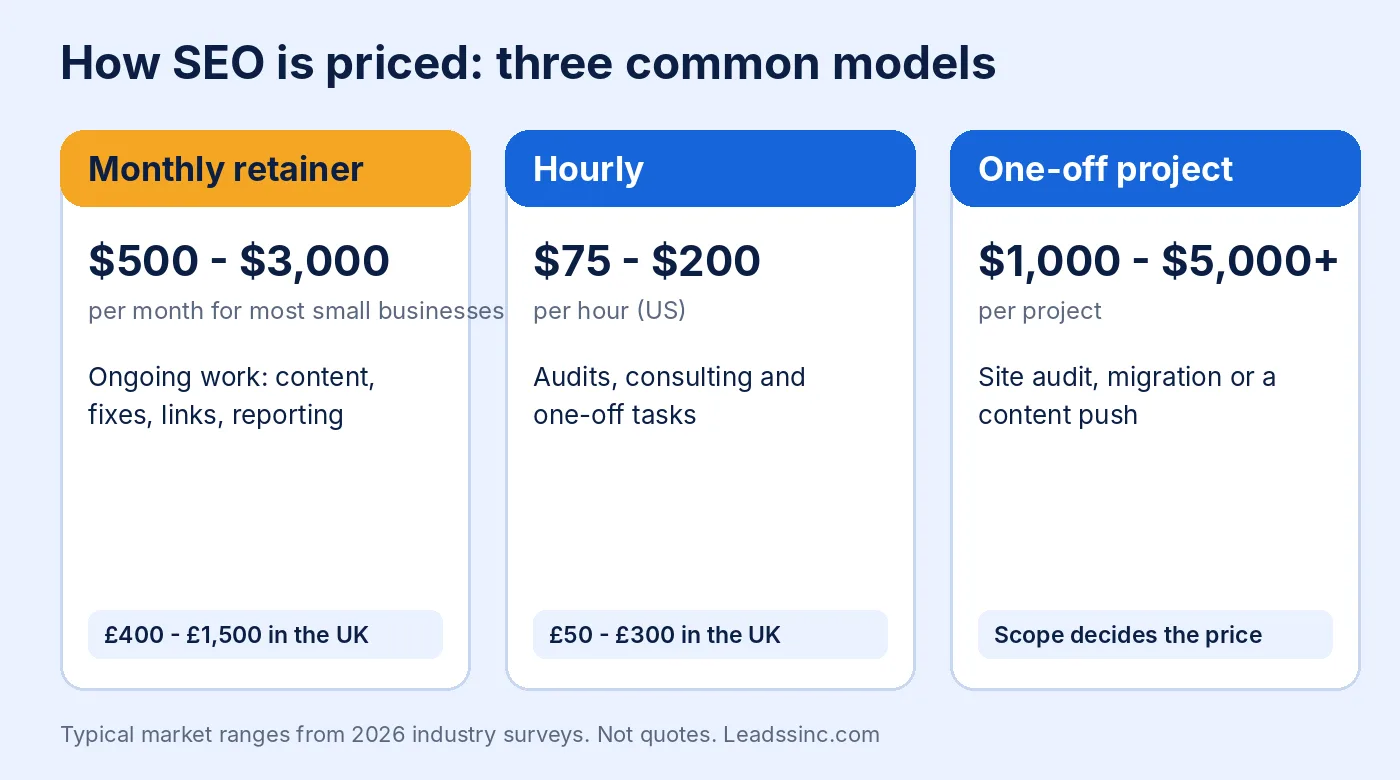
Industry surveys in 2026 put most small business SEO retainers between about $500 and $3,000 a month in the US, with a wide spread. Many providers charge between $1,500 and $3,000 for a small business that wants steady growth, while basic local SEO for a simple site can cost less. In the UK, small business retainers for local SEO commonly fall between roughly £400 and £1,500 a month.
Here are the three pricing models you will see:
- Monthly retainer: the most common model. You pay a set amount each month for ongoing work. Surveys suggest the large majority of SEO providers offer it.
- Hourly: typically about $75 to $200 an hour in the US and £50 to £300 in the UK. It suits audits, advice and one-off tasks, but gets expensive for ongoing work.
- One-off project: often $1,000 to $5,000 or more for a defined piece of work such as a site audit, a migration or a content push.
These are planning ranges from published surveys, not quotes. Prices depend on your industry, location and goals, so treat them as a guide.
What to do: Decide whether you need ongoing growth (a retainer) or a one-off fix (an audit or project). That single choice narrows your options quickly.
What affects the price of SEO?
Two businesses can pay very different amounts for good reasons.
- Competition: ranking for "plumber in a small town" costs less effort than ranking for "personal injury lawyer in Houston". Price follows competition more than it follows effort.
- Local or national reach: national and international campaigns cost considerably more than local ones because they target many more searches.
- Website size and condition: a 10-page site needs less work than a 500-page store, and a site with technical problems needs fixing first.
- Content needs: writing quality pages, guides and blog posts is a large part of the work, and quality content takes real time.
- Starting point: a new site with no authority needs more work than an established one with good links.
- Provider type: freelancers, small agencies and large agencies charge differently, and US-based agencies usually charge more than providers elsewhere.
What to do: Look up the businesses ranking above you for your main search terms. The stronger they are, the more SEO work you will need to compete.
Local SEO vs national SEO
If you serve customers in a town, city or region, local SEO is usually where to start. It focuses on your Google Business Profile, reviews, local pages and local mentions, and it typically costs less than national campaigns. One 2026 US survey put average local SEO spending around $1,500 a month, against more than $3,000 for national or worldwide campaigns, though individual quotes vary widely.
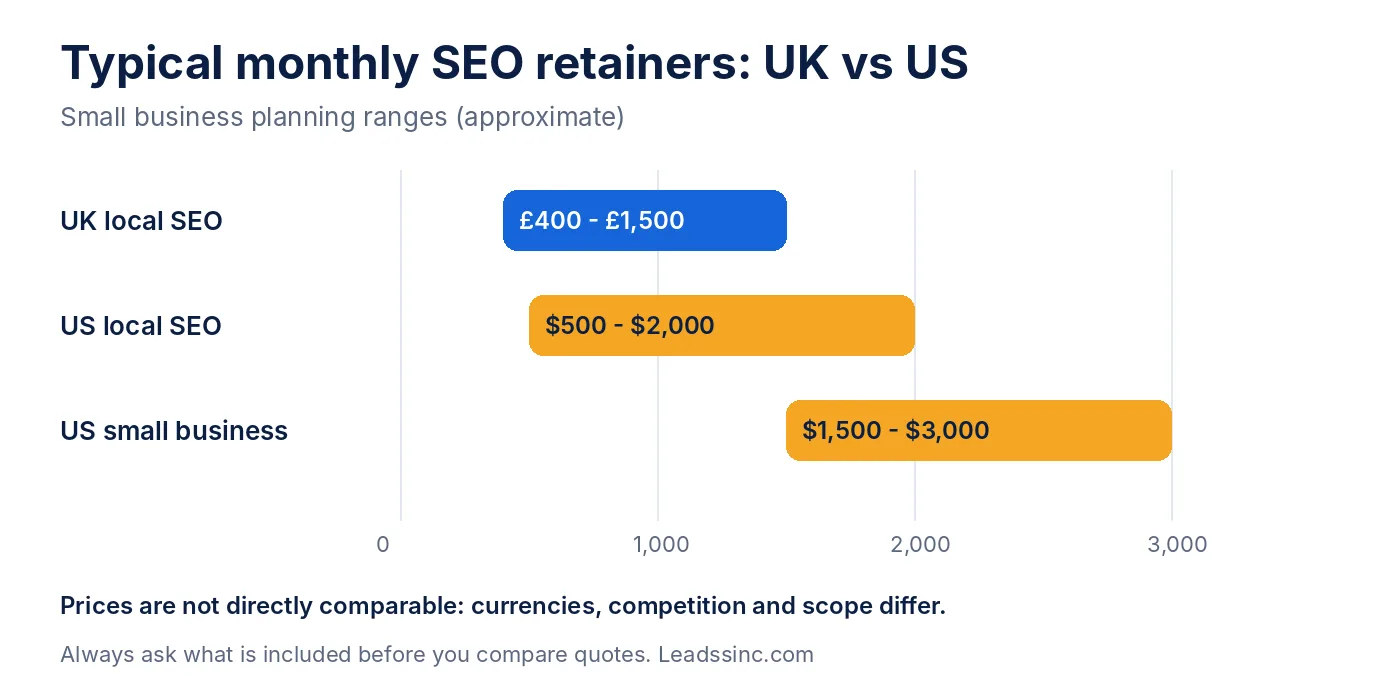
The UK market tends to sit slightly below the US for similar work, but the currencies, competition and scope differ, so do not compare the figures directly. What matters is what each quote includes.
What should SEO include?
A fair price should buy a clear list of work. A good small business SEO plan usually includes:
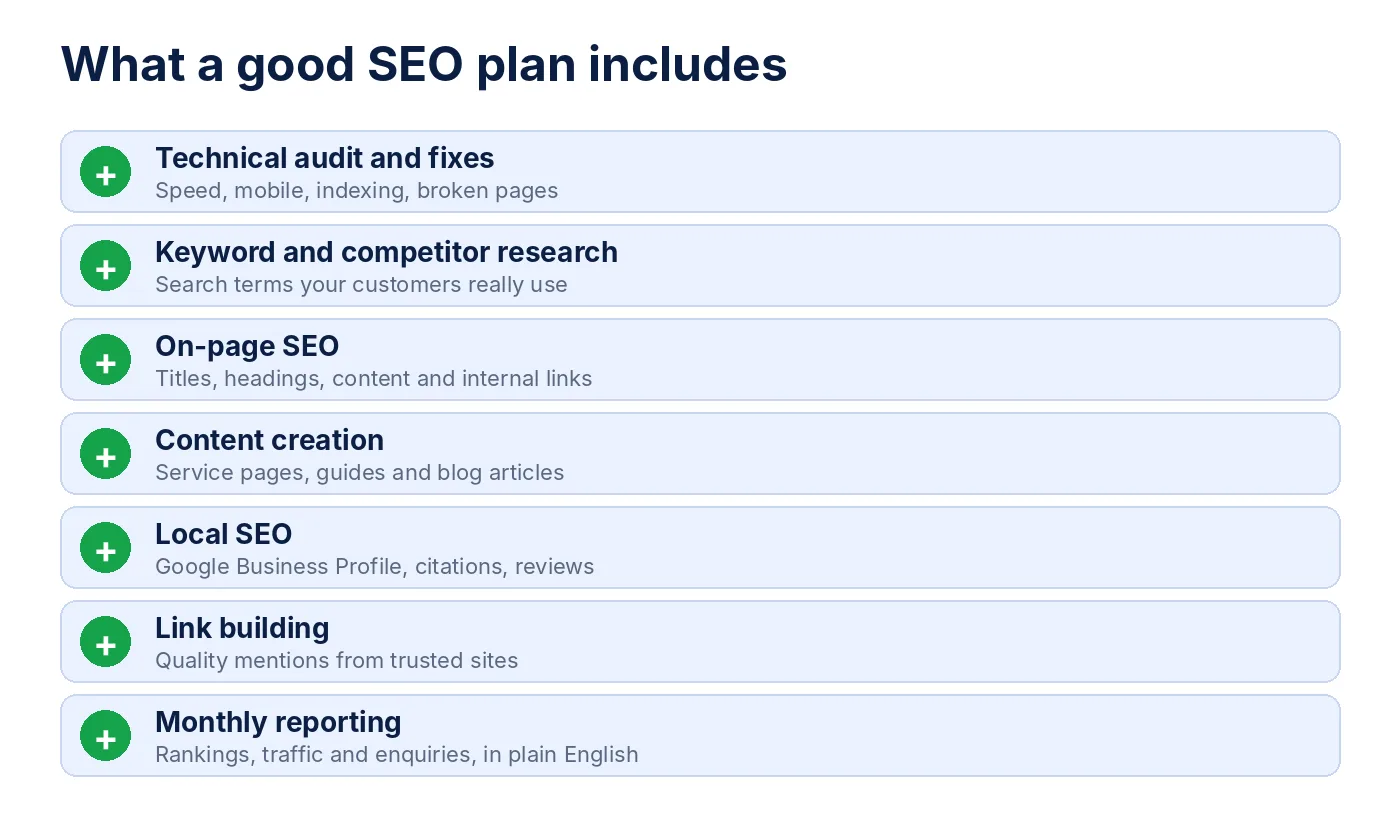
- Technical audit and fixes: speed, mobile use, indexing and broken pages. Slow or broken sites hold back everything else. If your site is slow, our guide to how much a website costs in 2026 explains why.
- Keyword and competitor research: finding the terms customers actually search for.
- On-page SEO: page titles, headings, content and internal links.
- Content creation: service pages, guides and blog articles that answer real questions.
- Local SEO: Google Business Profile, local citations and review strategy.
- Link building: earning quality mentions from trusted websites.
- Reporting: monthly updates on rankings, traffic and, most importantly, enquiries and sales.
Ask any agency to list exactly what you will receive each month. If the answer is vague, treat that as a warning.
How long does SEO take to work?
SEO is not instant. Most businesses start to see early movement in a few months and stronger results over six to twelve months, depending on competition and starting point. That is why retainers dominate, and why a one-month trial rarely tells you much.
SEO is also not a one-off purchase. Search results change, competitors keep working, and content needs updating. Think of it as an ongoing investment that builds over time, rather than an expense that stops paying when you stop.
What to do: Agree on goals beyond rankings, such as enquiries, calls or sales, and review them every month. Rankings alone do not pay the bills.
Red flags when you buy SEO
Not every quote is fair. Be careful if you see any of these:
- Guaranteed number-one rankings. Nobody controls Google, so nobody can honestly guarantee a position.
- Very cheap "comprehensive" packages. A $300 a month package that promises everything almost never delivers real work.
- No clear deliverables. You should know what is done each month.
- No access to your data. You should own your Google Analytics, Search Console and Business Profile accounts.
- Secret methods. Good providers explain their work in plain language.
- Bulk link packages. Paid links from low-quality sites can harm your site instead of helping it.
- Long lock-in contracts without results. Look for sensible notice periods.
On the other side of the scale, a very expensive quote for a small local business is probably more than you need. Ask why the scope is so large for your market.
How to choose an SEO provider
Price matters, but it should not be your only filter. Before you sign, check these points:
- Ask for examples and references. Look for real clients in similar industries, and ask what changed for them in enquiries, not just rankings.
- Ask for a short audit first. A paid or free audit shows how the provider thinks and whether they spot real problems on your site.
- Ask who does the work. Find out whether you will deal with an experienced person or a junior team, and who writes the content.
- Check the reporting. You should see traffic, enquiries and the work completed each month in plain language.
- Confirm ownership. Your accounts, content and data should stay yours if you leave.
- Match the plan to your budget. A focused plan on a smaller budget beats a huge plan that cannot be delivered.
A good provider will also tell you when SEO is not the right first step, for example when your website needs fixing or when paid ads would bring faster results.
What to do: Request quotes from two or three providers, ask each to list monthly deliverables, and compare the scope, not just the price.
SEO and your website
SEO works best on a website that is fast, clear and built to convert. If your site is slow, hard to use on mobile or poorly structured, spending more on SEO can waste money, because visitors leave before they enquire. Hosting, themes and plugins all affect speed, which is why we cover them in our guides to best web hosting and WordPress vs Shopify.
Fix the foundation first, then build traffic on top of it.
Common questions
Is SEO worth it for a small business? For many businesses, yes. Search is how many customers look for local services, and organic traffic keeps working without paying for every click. The return depends on your market, your site and the quality of the work.
How much should I spend on SEO each month? A common starting point for small US businesses is $1,000 to $3,000 a month, and in the UK about £400 to £1,500 for local SEO. A smaller budget can still work for a simple local business with low competition.
Can I do SEO myself? Yes, to a point. You can write good content, claim your Google Business Profile and ask for reviews. Technical work and link building are harder, and many owners hire help for those parts.
Is it better to hire a freelancer or an agency? Freelancers can cost less and suit smaller needs. Agencies offer a wider team for content, technical work and reporting. Judge the people and the process, not the label.
Is a monthly retainer better than a one-off project? For ongoing growth, a retainer usually works better because SEO needs continuous effort. A project fits a defined task such as an audit.
Ready to grow your search traffic?
Leadssinc helps businesses in the USA, the UK and worldwide get found on Google, with clear deliverables, honest reporting and no inflated promises. Tell us about your business and goals, and we will review your site and recommend a practical plan. Visit our SEO services page or explore our web development services, so your site is ready to turn search traffic into enquiries.
Found this useful?