How much does website maintenance cost in 2026? See typical monthly prices, what a plan should include, and whether to do it yourself or hire a freelancer or agency.
Most business owners budget carefully for building a website and then forget that the bill does not end at launch. A website is not a printed brochure. It runs on software that needs updating, a server that needs to stay online and content that needs to stay accurate. Skip the upkeep and small problems turn into slow pages, broken forms, security holes and lost customers.
This guide explains what website maintenance is, what it costs in 2026, what a fair plan should include and how to decide between doing it yourself, hiring a freelancer or paying an agency. It applies to businesses in the US, the UK and anywhere else.
What is website maintenance?
Website maintenance is the regular work that keeps your site secure, fast, working and up to date after launch. It is not the same as hosting. Hosting provides the server your site sits on, while maintenance looks after the site itself: software updates, backups, security, fixes and changes.
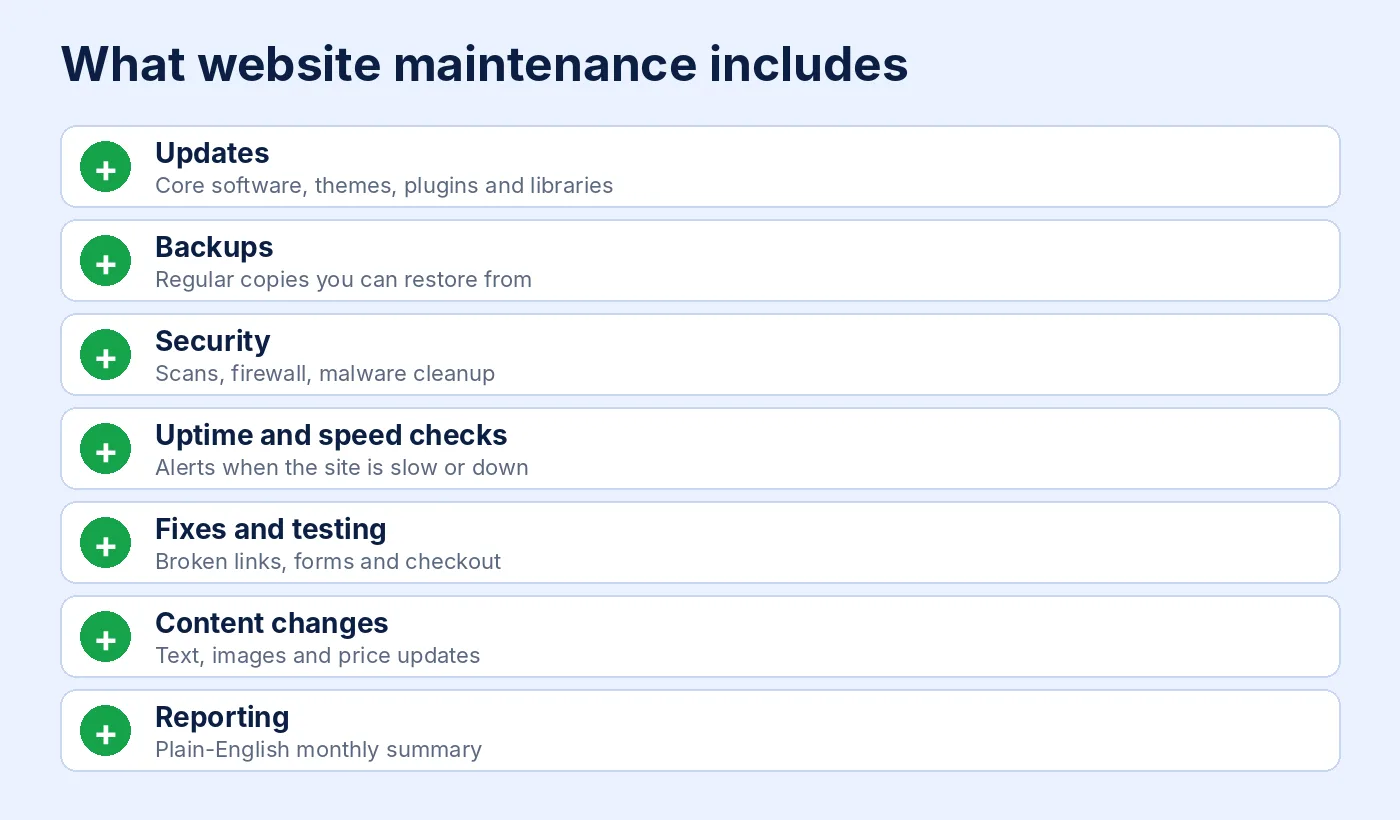
A good maintenance routine covers:
- Updates: WordPress core, themes and plugins, or the libraries a custom site depends on. Outdated software is one of the most common ways small business sites get hacked.
- Backups: regular copies of your site so you can recover quickly if something breaks.
- Security: scans, firewalls and cleanup if something goes wrong.
- Uptime and speed monitoring: alerts when the site goes down or slows.
- Fixes and testing: broken links, contact forms, checkout steps and mobile display.
- Content changes: updated text, images, prices and new pages.
- Reporting: a simple monthly summary of what was done.
What to do: Test your own contact form this week. A form that silently stopped working can cost enquiries for weeks before anyone notices.
How much does website maintenance cost in 2026?
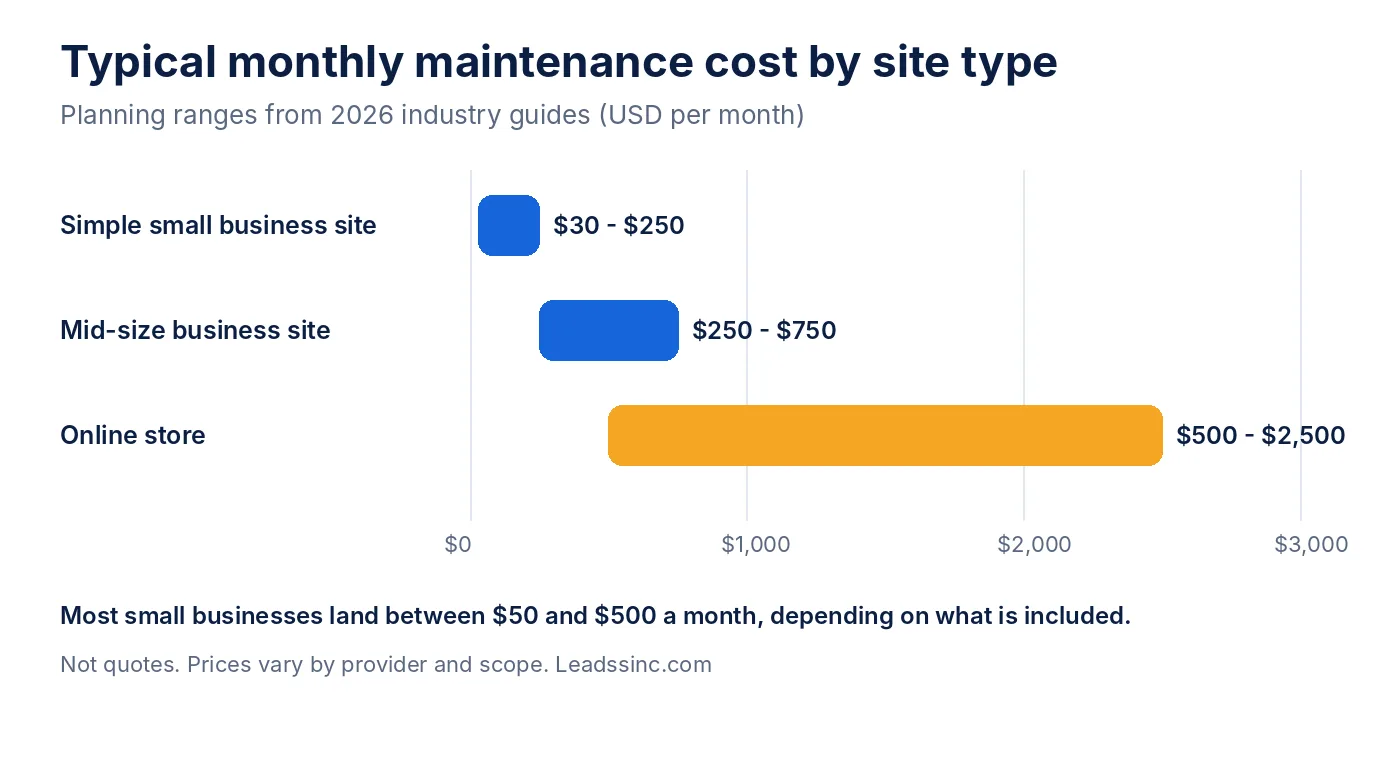
Published 2026 guides agree on one thing: the range is wide, and what the price includes matters more than the price itself. Most small business sites typically cost about $50 to $500 a month to maintain. Some guides split it by site type:
- Simple small business site: roughly $30 to $250 a month.
- Mid-size business or marketing site: roughly $250 to $750 a month.
- Online store: roughly $500 to $2,500 a month, because stores need more monitoring and have more that can break.
- Large or enterprise sites: $1,000 to several thousand dollars a month.
At the cheap end, basic managed plans from specialist providers advertise entry prices in the region of $39 to $79 a month per site for updates, backups and monitoring. UK businesses will find a similar pattern in pounds, with basic care plans at the lower end and full-service support at the higher end. These are planning ranges, not quotes.
Remember that managed hosting is not maintenance. Some hosts include automatic backups or updates, but they usually cover the server, not your plugins, custom code, forms or content. If you rely on hosting alone, you may be less protected than you think. Our guide to the best web hosting in 2026 explains what hosting does and does not cover.
What to do: Ask every provider for a written list of exactly what is included each month. Two plans with the same price can cover very different amounts of work.
What affects the price of maintenance?
- Platform: WordPress sites need regular plugin and theme updates. A well-built custom site often has fewer moving parts but needs a developer for changes.
- Number of plugins and integrations: every extra plugin or connected service is another thing that can break or become outdated.
- Site size and traffic: larger, busier sites need stronger monitoring and hosting.
- Online store features: payments, stock, shipping and customer accounts raise the stakes, and the cost.
- How often you change content: frequent edits cost more than a site that rarely changes.
- Response time: same-day support costs more than a standard turnaround.
- Provider type: freelancers, small agencies and large agencies price differently.
A heavy theme with many plugins is not just slower. It is also more expensive to maintain, which is one reason we recommend clean builds in our guide to how much a website costs in 2026.
Other yearly costs people forget
Maintenance fees are only part of what it costs to keep a site running. Budget for these too:
- Domain renewal: usually $10 to $50 a year.
- Hosting: from a few dollars a month for small sites to much more for busy stores.
- Premium plugin and theme licences: many renew yearly.
- SSL certificate: often free with hosting, but some premium certificates cost extra.
- Business email: usually a monthly cost per mailbox.
- Content and SEO: new pages, blog posts and ongoing optimisation. See our guide to how much SEO costs for a small business.
- Future redesigns: most sites need a refresh every few years.
What to do: Add up your yearly total for domain, hosting, licences, email and maintenance. That number is your real cost of owning a website.
DIY, freelancer or agency plan?
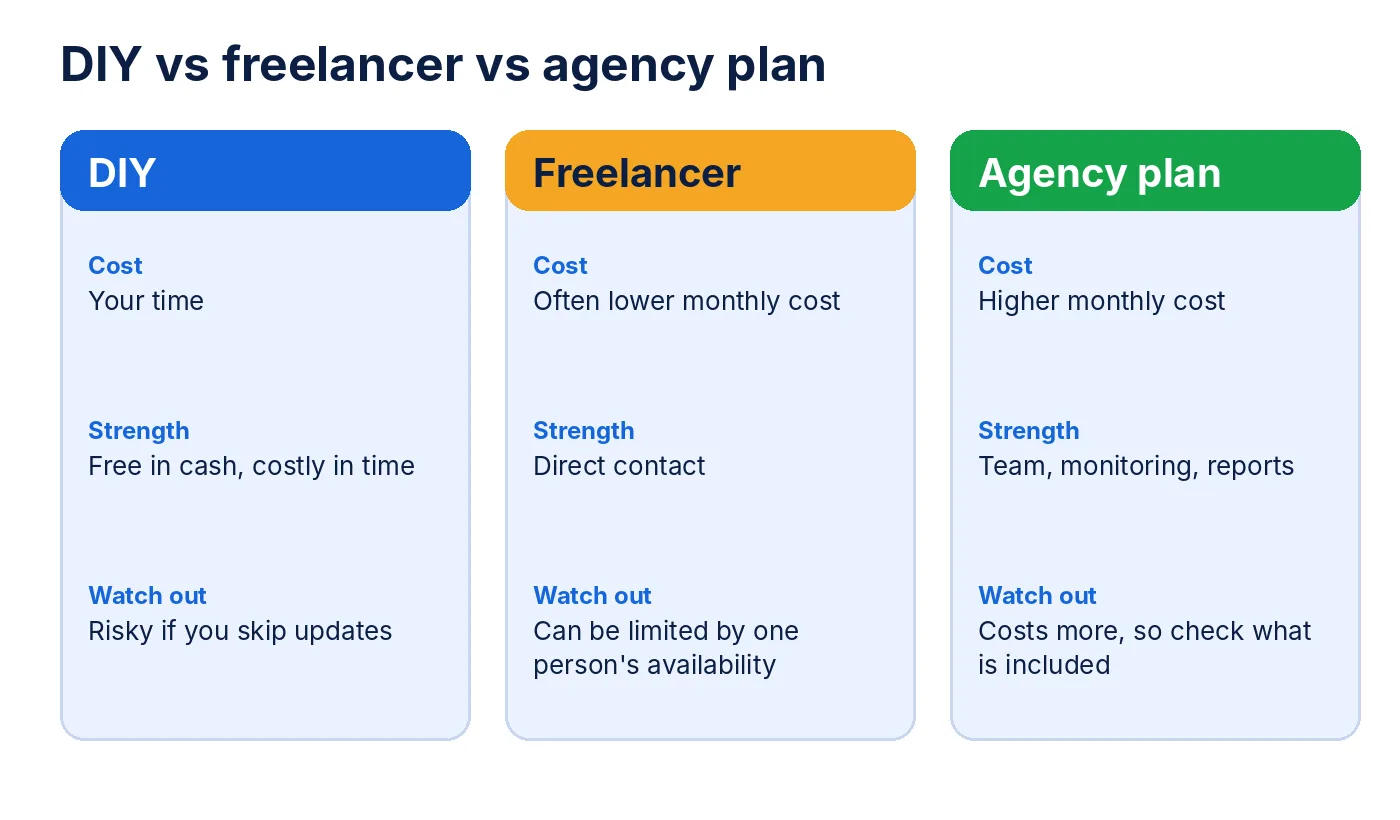
Doing it yourself costs no money but takes time and skill. It can work for a simple site if you are comfortable updating software, restoring backups and spotting problems. The risk is skipping updates when you are busy, and nobody noticing until something breaks.
A freelancer often offers lower monthly pricing and direct contact. The risk is availability: if one person is away or overloaded, your site waits.
An agency maintenance plan usually costs more but provides a team, monitoring, a clear process and regular reports. It suits sites where downtime or security problems would cost real money.
Whichever you choose, make sure the arrangement is written down: what is included, how quickly problems are fixed and how many hours of changes you get each month.
What happens if you skip maintenance?
Skipping maintenance feels like saving money until something goes wrong. Typical consequences include:
- Security breaches from outdated plugins and themes.
- Downtime that costs sales and damages trust.
- Slow pages as databases, images and plugins pile up.
- Broken forms and links that quietly lose enquiries.
- Lower search rankings if speed, errors and outdated content build up.
- Expensive emergency fixes that cost more than a monthly plan would have.
A hacked or broken site is almost always more expensive to fix than to prevent.
How to choose a maintenance plan
Before you sign, check:
- What is included. Updates, backups, security, monitoring, fixes and content changes should be listed.
- How backups work. Ask how often they run, where they are stored and how quickly you can restore.
- Response times. Find out how fast urgent problems are handled.
- Hours for changes. See how many content or design changes are included and what extra hours cost.
- Reporting. You should receive a clear monthly summary.
- Ownership and access. You should keep control of your logins, domain and hosting accounts.
- Contract terms. Look for a sensible notice period and no hidden fees.
It also helps to hire someone who understands your site, ideally the team that built it. If you are choosing a provider, our guide to how to choose a web design and development agency lists the questions to ask.
What to do: Ask the agency that builds your website to quote the first year of maintenance up front, so you see the full cost before you commit.
Common questions
How much should I budget for website maintenance? A common range for small business sites is about $50 to $500 a month, with online stores and complex sites costing more. A simple brochure site can cost less, and the right amount depends on what you need covered.
Do I need maintenance if I have a custom website? Yes, though the work differs. Custom sites have fewer plugin updates but still need hosting checks, security updates for libraries, backups, monitoring and changes when you need them.
Is hosting the same as maintenance? No. Hosting provides the server. Maintenance looks after the site itself, including software updates, security, fixes and content changes.
Can I maintain my website myself? For a simple site, yes, if you update software regularly, keep backups and check that forms work. Many owners find it easier to hand this off as the business gets busier.
How often should a website be maintained? Security and software updates should happen regularly, and many providers run them weekly or monthly. Content should be reviewed at least monthly to keep prices, offers and contact details correct.
Are website maintenance plans worth it? For most businesses that rely on their site for leads or sales, a plan is cheaper than dealing with a hack, a crash or lost enquiries. The value depends on a clear scope and a provider who responds quickly.
Need help keeping your website healthy?
Leadssinc builds and looks after websites for businesses in the USA, the UK and worldwide, from WordPress and Shopify to custom-coded sites. If you want a clear plan for updates, backups, security and changes, tell us about your site and we will recommend a simple, honest care plan. Visit our web development services, or use our cost calculator to estimate your project.
Found this useful?